Introduction: Why Agentic AI Is Suddenly Everywhere
Business processes are changing and it’s happening much faster than most people thought they would. From chatbots to automation tools, AI has already entered our lives. But now we have something far better—systems that respond, but actually act on their own.
That’s where it gets important to think about what is agentic AI.
Now, companies are looking at intelligent systems such as conversational AI agents for businesses, automated decision-making tools, and even platforms like Vertex AI Agent Builder for creating intelligent workflows. Design and media are using tools like stock illustration voice AI agents and visual automation powered by AI agent icon driven interfaces.
It’s not just a tech upgrade. It’s also a shift in the way work gets done.
What is Agentic AI? (Clear and Simple Explanation)
Agentic AI is an artificial intelligence type that does not just follow the instructions but can also take initiative.
Instead of waiting for step-by-step commands, you can instead:
- Understand a goal. The goal is to improve on an existing one.
- Divide the chore into smaller tasks.
- Make decisions based on the information you receive.
- Take action to finish the work.
So, when people ask “What is agentic AI?” The answer is: It is AI that behaves like an independent digital worker.
Unlike other AI tools, agentic AI does more than just make suggestions; it actually performs tasks.
You can write as the following:
- A normal AI chatbot answers questions.
- An agentic AI system can check your email, schedule meetings, and follow up automatically.
That makes this tool a powerful upgrade in automation.
Why Agentic AI Matters in Modern Business
Today, businesses are confronted with too much data, too many tools, and not enough time. That’s where agentic AI comes in.
Rather than just helping humans, it starts handling entire workflows.
This is particularly useful in:
- HR departments managing recruitment pipelines
- Customer service handling repetitive queries
- Marketing teams running automated campaigns
- IT systems monitoring and fixing issues
The rise of conversational AI agents for businesses shows that companies are moving toward systems that can talk, think, and act like real assistants.
In short, companies want AI that does more than just suggest action—it performs it.
How Agentic AI Works Behind the Scenes
For more background on these systems, lets break them down.
1. Goal Understanding
The system starts off with a goal, such as improving customer support or sales efficiency.
2. Task Planning
It breaks that goal into smaller steps: gathering data, looking for patterns, and taking action.
3. Decision Execution
The AI decides which actions are best based on the data.
4. Continuous Learning
It improves over time by learning from the results and adapting its strategy.
So what makes agentic AI different from other AIs is that it doesn’t stop after one action, but keeps going until the goal is accomplished.
Key Tools and Technologies Powering Agentic AI
Agentic AI is not just a concept; it’s supported by real platforms and tools that businesses are already using.
1. Vertex AI Agent Builder
One of the most powerful tools in this space is Vertex AI Agent Builder. It allows developers to create intelligent AI agents that can handle complex tasks, integrate with APIs, and automate workflows.
Businesses use it to build custom AI systems without starting from scratch.
2. Conversational AI Agents for Businesses
These agents are designed to interact with customers and employees naturally.
They can:
- Answer support queries
- Handle bookings
- Provide product recommendations
- Automate HR communication
This is where conversational AI becomes more than chat—it becomes action-driven assistance.
3. Stock Illustration Voice AI Agent
Creative industries are also adopting AI tools like stock illustration voice AI agent systems. These tools help generate or manage visual content using voice commands or automated workflows.
Design teams can now request illustrations, edits, or variations without manual effort.
4. AI Agent Icon and Visual Interfaces
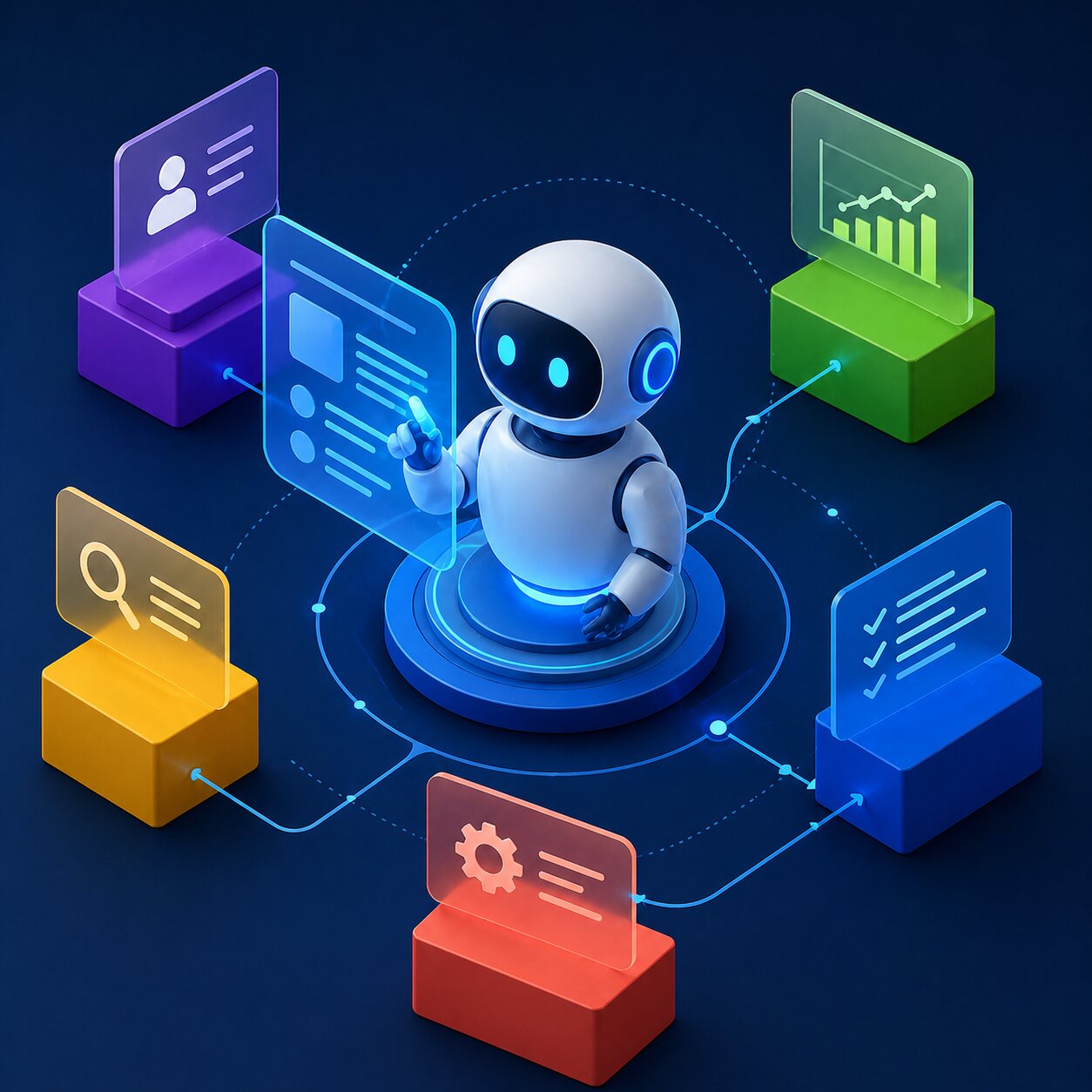
As AI systems become more common, the AI agent icon has become a visual representation of automation tools in dashboards and apps.
It helps users quickly identify where intelligent automation is active in a system.
Agentic AI Use Cases in Real Life
The real power of agentic AI becomes clear when we look at its applications.
1. HR Automation
- Resume screening
- Interview scheduling
- Candidate follow-ups
2. Customer Support
- Auto-replying to queries
- Resolving common issues
- Escalating complex problems
3. Marketing
- Running ad campaigns
- Analyzing performance
- Optimizing content strategy
4. Finance
- Fraud detection
- Report generation
- Budget forecasting
5. Creative Workflows
- Generating visuals using stock illustration systems
- Voice-based content creation
- Automated design suggestions
These agentic AI use cases show how deeply this technology is entering everyday business operations.
Benefits of Agentic AI
For this reason, many companies are focusing on this technology:
- Speedier workflows without manual errors.
- Arbeits load reduction for employees.
- Smarter decision-making based on data.
- This specialized service is available in all countries across the globe 24/7.
- Automation at scale across departments.
- Better customer experience through immediate response to queries.
With software like Vertex AI Agent Builder, companies can create systems that feel like virtual employees.
Common Challenges and Things to Watch
Although agentic AI is powerful, it’s not perfect.
1. Over-Automation Risk
As technology evolves, so must a certain degree of automation.
2. Data Quality Issues
Data that is not valid leads to bad decisions.
3. Integration Complexity
Connecting AI agents to existing systems can be complex.
4. Security Concerns
Autonomous systems must be controlled judiciously to avoid misuse.
The key is balance—AI should support humans, not completely replace judgement.
The Future of Agentic AI
The future looks exciting and a little unpredictable.
We are moving toward a world where:
- AI agents manage full workflows for employees and customers.
- Businesses rely on automation teams.
- Tools like conversational AI agents for businesses become standard.
- Platforms like Vertex AI Agent Builder are used in enterprise automation.
- Creative industries use stock illustration voice AI agent systems every day.
Even the way we interface with software is changing, such as displaying icons for AI agents in dashboards and apps.
This is no longer simply automation, it’s autonomous digital collaboration.
Conclusion: A New Era of Intelligent Automation
So, if we look at what is agentic AI, we’re talking about more than just software: we’re talking about systems that can think, act, and improve themselves.
From conversational AI agents for businesses to advanced platforms like Vertex AI Agent Builder, and even creative tools like stock illustration voice AI agent, everything points to a future where AI is an active partner in work.
At HR Tech News Today, the mission is simple—understand these changes so businesses and professionals can keep up without feeling overwhelmed.
The future of work is not just digital but agent driven. Read more: Human Resources Technology
Faqs
What is agentic AI and how does it work in simple terms?
Agentic AI is a type of artificial intelligence that can think, plan, and take actions on its own to complete tasks. Instead of only responding to commands, it breaks down goals into steps and executes them using data and tools, making it more autonomous than traditional AI systems.
What are the real-world use cases of agentic AI in business?
Agentic AI is widely used in HR, customer service, marketing, and operations. It can automate hiring processes, manage customer queries, run marketing campaigns, analyze data, and even perform decision-making tasks without constant human input.
How are conversational AI agents for businesses different from chatbots?
Conversational AI agents for businesses go beyond basic chatbots. They can understand context, perform multi-step tasks, and take actions like booking meetings, resolving support issues, or updating systems, instead of just giving scripted responses.
What tools are used to build agentic AI systems?
Popular tools include Vertex AI Agent Builder, AI automation platforms, and enterprise AI frameworks. These tools help developers create intelligent agents that can integrate with business systems, automate workflows, and perform complex tasks efficiently.