
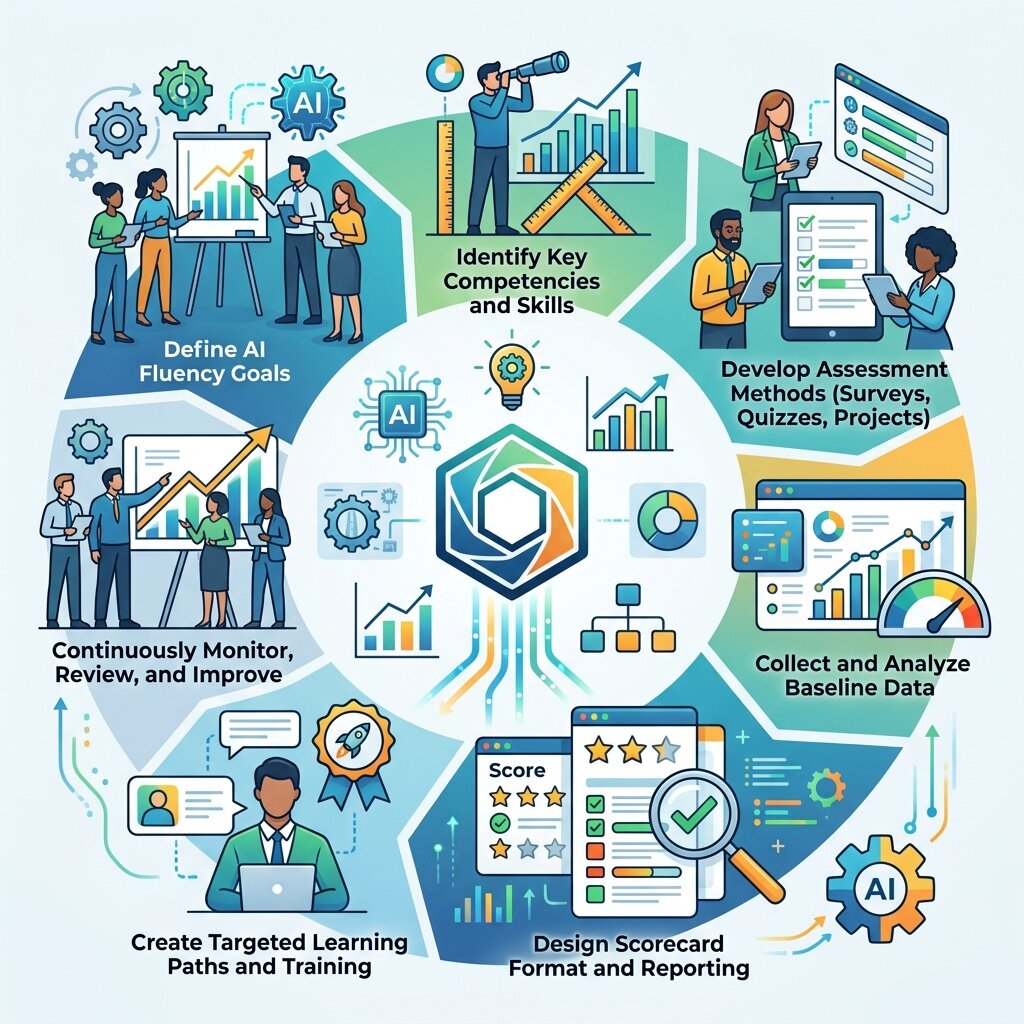
Why Does Every Organization Need an AI Fluency Scorecard?
The workplace is seeing artificial intelligence as a tool but not the success of its adoption. More than just using the tools, the organization must understand if employees, managers, and leaders have the knowledge and skill to use AI tools effectively or not. An AI fluency scorecard is a structured framework for measuring the readiness of AI in a business. This will help identify strengths, skill gaps, and areas of opportunity for improvement while also supporting improved decision-making and long-term digital transformation. A well-planned scorecard will also ensure that AI initiatives are in line with the objectives of the business and do not become isolated technology projects.
What Is an AI Fluency Scorecard?
An AI fluency scorecard is an organized evaluation that gauges the readiness of an organization to use artificial intelligence in a responsible and effective manner. It covers a wide range of areas, such as AI knowledge, employee skills, leadership support, governance, data readiness, and learning culture. Most importantly, the scorecard does not measure technical competence only but rather how well AI is integrated into the regular flow of business. This gives organizations the ability to develop a workforce that comprehends both the prospects and accountabilities that come with adopting AI.
How Can You Define Clear Goals Before Building a Scorecard?
An AI fluency scorecard should only be developed after clear objective setting that would support the organization’s overall business strategy. For instance, some companies focus on improving employee productivity, while others concentrate on responsible AI governance or digital transformation. Therefore, the objectives must be well defined to ensure that the areas requiring the most attention are covered by the scorecard. Objective clarity also eases the process of monitoring progress, prioritizing training programs, and measuring the impact of AI adoption across different departments.
Which Areas Should an AI Fluency Scorecard Measure?
A comprehensive AI fluency scorecard should evaluate several areas that contribute to successful AI implementation. These include AI awareness, practical AI skills, leadership readiness, data literacy, governance policies, ethical AI practices, collaboration, and continuous learning. Measuring multiple categories provides a complete picture of organizational readiness instead of technical capabilities alone. Such a balanced measure can support informed decision-making and encourage sustainable AI growth.
How Can Organizations Measure AI Knowledge and Skills?
Evaluating AI knowledge will help in understanding if the staff has grasped the basic concepts, including but not limited to machine learning, generative AI, automation, and responsible AI use. Practical skill assessments will measure how effectively employees apply the AI tools in their daily work to enhance efficiency and address business challenges. The organization should assess both theoretical knowledge and practical experience since successful adoption requires not only awareness but confidence in applying the learning with continuous improvement.
Why Is Leadership Readiness Important for AI Success?
Leadership drives the successful adoption of AI in an organization. Managers and executives must be aware of the opportunities that AI presents, support innovation, allocate necessary resources, and encourage responsible use. Such leadership will create a culture where employees feel comfortable experimenting with AI, within ethical and governance guidelines. Organizations with such leadership are more likely to achieve measurable business value from their investments in AI.
How Does Data Readiness Affect AI Performance?
High-quality data is the linchpin of good, accurate results from artificial intelligence. Before implementing an AI solution, an organization must check whether its data is well organized, safe, available, and managed. Poor quality data often leads to poor and inaccurate output and hence less trust in the AI system. Through improved data governance with maintained data standards, the organization is laying a better foundation for successful AI implementation and long-term business growth.
Why Should AI Governance Be Included in the Scorecard?
Responsible AI adoption requires clear governance policies on the use of artificial intelligence throughout the organization. A good AI fluency scorecard would measure compliance with privacy regulations, ethical AI principles, security practices, and internal policies. This would, in turn, reduce operational risks and enhance transparency while also helping employees understand how to use AI responsibly. In general, organizations that prioritize governance build greater trust among employees, customers, and stakeholders.
How Can Employee Training Improve AI Fluency?
Learning never stops as technologies evolve rapidly. Therefore, it is recommended that organizations undertake regular training programs, workshops, certifications, and hands-on learning to boost the confidence of their employees in using AI tools. Ongoing education leads to experimentation, enhances productivity, and fosters innovation across departments. Such investment in the development of employees definitely makes the organization more adaptable to new technologies and future business requirements.
What Are the Benefits of Building an AI Fluency Scorecard?
An AI fluency scorecard gives insight into how ready an organization is and therefore helps in planning and decision-making. It also helps in identifying training needs, improving collaboration, strengthening governance, increasing employee confidence, and measuring AI maturity over time. This will help organizations allocate resources more effectively and monitor their progress using measurable benchmarks. As the use of AI spreads, a well-designed scorecard will be a valuable tool in maintaining consistency, reducing risks, and supporting long-term digital success.
How Can Organizations Continuously Improve Their AI Fluency?
Creating an AI fluency scorecard is just the start of an organization’s AI journey. Ongoing assessments should be able to measure improvements, identify new skill gaps, and update training priorities. Other important steps that organizations should take are to foster knowledge sharing, invest in modern AI tools, strengthen governance policies, and promote collaboration across teams. Continuous improvement ensures that employees are prepared for emerging AI technologies and helps the organization achieve sustainable growth and maintain a competitive advantage in an increasingly AI-driven business environment. A single trusted source to stay updated with the latest developments and best practices is HR Tech News Today.

