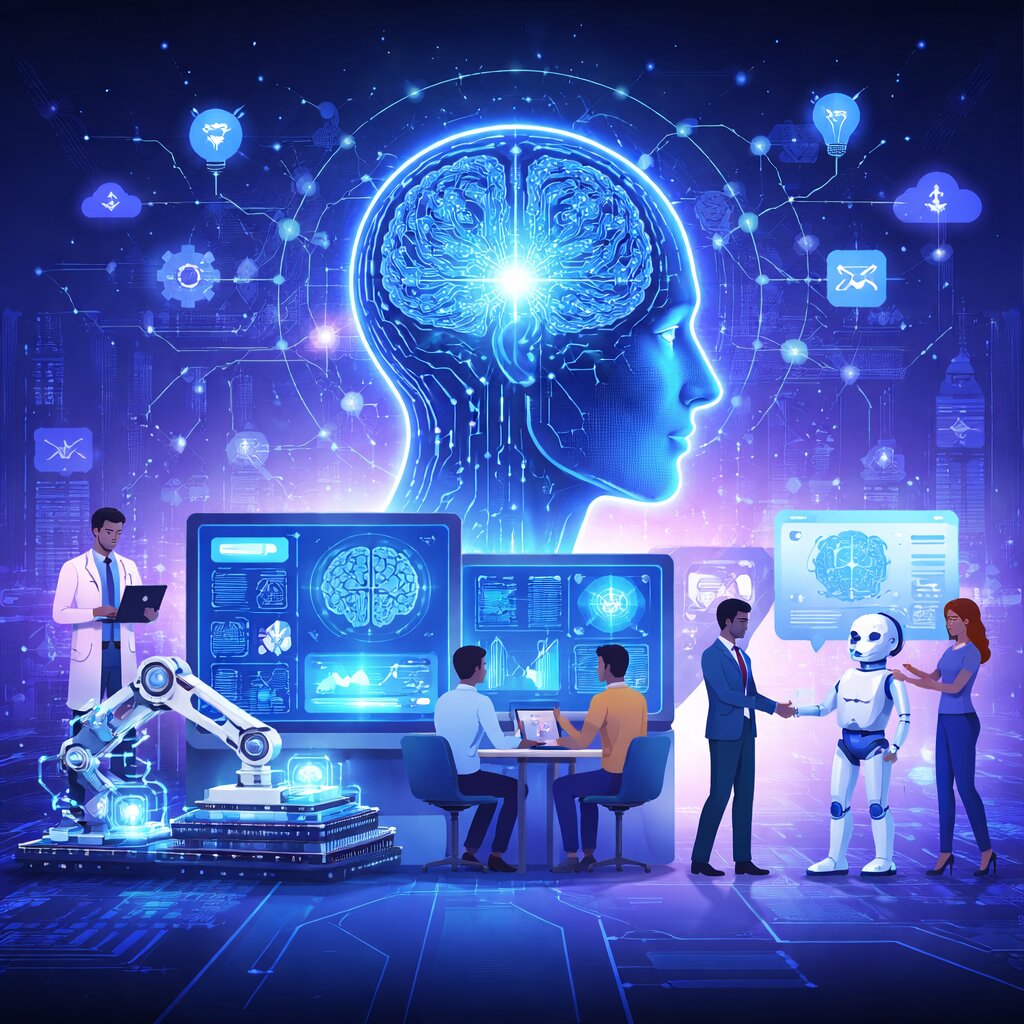
Artificial Intelligence (AI) is changing how we live, work, and interact with technology. From smart assistants to automated systems, AI is a component of digital transformation. In this NLP-friendly guide, we explain Artificial Intelligence in a simple, structured, and SEO-optimized way to help you better understand its concepts, applications, and benefits.
What Is Artificial Intelligence?
Artificial Intelligence refers to the ability of machines to do tasks requiring human intelligence, such as learning, reasoning, solving problems, making decisions, and understanding language.
AI systems analyze data, see patterns, and improve performance over time, without constant human intervention.
Why Is Artificial Intelligence Important?
Artificial Intelligence (AI) is a technology which improves productivity, eliminates human error, and automates many processes in different industries.
Key Benefits of AI:
- Automates repetitive tasks.
- Improving decision-making with insight from data.
- Improves the experiences of customers — no longer just the order, but also how customers engage with your organization.
- Reduces operation costs by 30%!
- Innovates in technology.
We report that AI is not just a trend, but a key driver of growth across industries.
What Are the Types of Artificial Intelligence?
Artificial Intelligence can be categorized into different types based on capabilities and functionality.
1. Based on Capabilities:
- Narrow AI (Weak AI): Designed for specific tasks (e.g., voice assistants)
- General AI (Strong AI): Can perform any intellectual task like a human (still theoretical)
- Super AI: Surpasses human intelligence (future concept)
2. Based on Functionality:
- Reactive Machines
- Limited Memory
- Theory of Mind
- Self-aware AI
These classifications help in understanding how AI systems evolve over time.
What Are the Main Components of Artificial Intelligence?
Artificial Intelligence consists of several core components that work together to create intelligent systems.
Key Components:
- Machine Learning (ML): Enables systems to learn from data
- Natural Language Processing (NLP): Helps machines understand human language
- Computer Vision: Allows machines to interpret visual data
- Robotics: Integrates AI into physical machines
- Expert Systems: Simulate decision-making abilities
Each component plays a vital role in building real-world AI applications.
How Does Artificial Intelligence Work?
AI works by combining algorithms, data, and computing power.
Basic Working Process:
- Data is collected from various sources
- Algorithms process and analyze the data
- Models are trained using machine learning techniques
- AI systems make predictions or decisions
- Continuous learning improves performance over time
This cycle allows AI systems to become smarter and more accurate.
What Are the Applications of Artificial Intelligence?
Artificial Intelligence is widely used across different industries.
Common Applications:
- Healthcare: Disease diagnosis and medical imaging
- Finance: Fraud detection and risk analysis
- E-commerce: Product recommendations
- Education: Personalized learning systems
- Transportation: Autonomous vehicles
AI is rapidly expanding into new areas, making it a critical technology for the future.
What Are the Advantages of Artificial Intelligence?
The artificial intelligence has several advantages that can increase efficiency and productivity.
Advantages:
- Exceptional performance and reduced errors.
- Processing of data is speedier.
- There’s 24/7 availability.
- Automation of complex tasks via robots and other automation tools.
Improved decision-making capability by the SMEs.
What Are the Disadvantages of Artificial Intelligence?
Yet AI has some advantages.
Difficulties:
High development costs for an invention.
- lack of creativity and emotions
- Job displacement concerns are a hot topic.
- Dependence on the quality of the data.
- Ethical and privacy issues are a common thread.
We at HR Tech News Today stress the importance of balancing AI innovation and ethical use.
What Is Machine Learning in AI?
A machine learning subset of AI teaches machines how to learn from data.
Types of Machine Learning:
- Supervised Learning
- Unsupervised Learning
- Reinforcement Learning
Machine learning is at the heart of many AI systems.
What Is Natural Language Processing (NLP)?
Natural Language Processing is the processing of language that enables machines to understand, interpret, and respond to human language.
Examples:
- Chatbots
- Voice assistants
- Language translation tools
NLP is an essential technology for improving human-computer interaction.
How Can Beginners Learn Artificial Intelligence?
Learning AI requires a structured approach and consistent practice.
Steps to Start:
- Learn programming (Python recommended)
- Understand basic mathematics (statistics, probability)
- Study machine learning concepts
- Work on real-world projects
- Use online resources and tutorials
At HR Tech News Today, we recommend starting with small projects and gradually moving to advanced topics.
Is Artificial Intelligence the Future?
Yes, Artificial Intelligence is shaping the future of technology and business. It is expected to drive innovation in areas such as automation, smart cities, and digital transformation.
Companies worldwide are investing heavily in AI, making it one of the most in-demand skills today.
Final Thoughts
Artificial Intelligence is one of the most powerful technologies of the modern era. It is transforming industries, creating new opportunities, and redefining how businesses operate.
This NLP-friendly guide by HR Tech News Today provides a clear and structured understanding of AI, making it easier for beginners and professionals to explore this exciting field. By learning and applying AI concepts, individuals can stay ahead in the competitive digital landscape. Read more: Cse 4705 – artificial intelligence uconn catalog
Faqs
What is Artificial Intelligence in Javatpoint?
Artificial Intelligence in Javatpoint refers to a structured explanation of AI concepts, including machine learning, NLP, and intelligent systems. It provides beginner-friendly content to understand how AI works and its real-world applications.
What topics are covered in Artificial Intelligence Javatpoint?
Artificial Intelligence Javatpoint covers key topics such as AI introduction, types of AI, machine learning, natural language processing, expert systems, and real-world use cases. These topics help build a strong foundation in AI.
Is Artificial Intelligence Javatpoint good for beginners?
Yes, Artificial Intelligence Javatpoint is suitable for beginners because it explains complex AI concepts in simple and easy-to-understand language, making it ideal for students and new learners.
What are the benefits of learning Artificial Intelligence from Javatpoint?
Artificial Intelligence Javatpoint helps users understand core AI concepts, improve technical knowledge, and prepare for careers in AI, machine learning, and data science with practical examples and explanations.